Showing posts with label young adult fiction. Show all posts

Wednesday, September 23, 2015

Danny Dragonbreath is your typical youngster.  He puts up with his father’s good-natured lectures.  He goofs off instead of doing school work, waiting until the last minute to eek out something off the top of his head.  He dreams of being a pirate.  And he’s not very good at breathing fire.  Unfortunately, since Danny is an actual dragon, that last one poses a bit of a problem.  He practices every day, but he can’t seem to figure out the internal mechanics to make it work, no matter how much he thinks “hot” like his father says.

Danny and his best friend Wendell, an iguana, take a trip to the sea shore to visit Danny’s cousin Edward, a sea serpent.  Danny needs to write a report on the ocean to make up for the abysmal, last minute fiction he tuned in on ocean-dwelling bats.  Instead of going to the library, like Wendell urges, Danny wants to experience the ocean first hand, and enlists his kindly cousin for the project.

Danny and Wendell get to see a coral reef up close, they get chased by a shark, find a sunken ship, and nearly get eaten by a giant squid.  All in all, it was a grand adventure.  Danny laughs off each near death experience, and seems to actual learn a thing or too, despite his best efforts to just have fun.  Wendell is rather terrified most of the time, but discovers that he actually knows more about the ocean than he had realized, and even finds just how tough he can actually be and manages to stand up to the school bully the next day.


This is a charming story of learning how to make learning fun.  It is about facing one’s fears, and seeing that you are stronger than you could have ever imagined.  Danny Dragonbreath is a wonderful character, and the mix of comic-like illustrations every 3 or 4 pages makes the story a joy to read.

Monday, September 21, 2015

I'm done with The Boxcar Children series, after the catastrophe that is #24 "The Mystery of the Hidden Painting"

1111065
I’m trying to remember why I used to like these books so much when I was a kid.  I must have checked out a dozen of them each time we went to the library when I was about 7-years-old.  I thought they were funny and a little suspenseful.  I even did a book report on one of their adventures at a dude ranch.  But now…I guess I just grew up, or developed a better literature palette, or something, because these books are just not well written.

The language is forced, awkward, and often pretentious.  No one actually talks like this, and certainly not children.  The writer feels the need to bring up the boxcar, and why the children lived there, every other page.  Sure, not everyone who picks up a Boxcar Children book is going to know the story of why they are called that, but surely they’ll remember being told three pages ago – you don’t need to say it so many times within the same book.

As for the mystery that the children get to solve, it had potential – they want to find the long lost (presumed stolen) necklace of their late grandmother, in time for their grandfather’s birthday.  (By the way, how many kids actually call their grandfather “Grandfather”?)  They see a photo of a woman in the newspaper (how many 12-year-olds read the newspaper) who appears to be wearing the necklace and immediately concoct a scheme to interrogate the woman.  Of course, multiple people in the village try to scare away the children: calling them late at night, following them in a car with tinted windows.  And when the children don’t get the information they want, they latch onto a “clue” on a return address label that happened to come from a town right next to where the necklace had been stolen from.

The overreaction of the townsfolk to the children’s investigation is downright absurd.  It’s not like the police were pounding down doors, it was a couple of kids who just wanted to know what happened to their grandmother’s necklace.  If the people really wanted to keep it a secret, they should have lied politely to the children’s faces instead of acting rude and suspicious.

The mystery ends, like always, with a non-forced confession from the perpetrator and, of course, no involvement from the police.  The culprit gets away with it, and the children and their grandfather even allow for the necklace to stay where it was (in a museum in the middle of nowhere).  The incredibly unrealistic ending is a fit for the incredibly unrealistic plot, and neither are worth the trouble of putting up with that horrid writing style.

I may have loved the Boxcar Children when I was Benny’s age, but I think children today deserve better writing than this series has to offer.

Monday, September 14, 2015

American Girl faulters with "Peril at King's Creek."

114689
I had a very hard time getting past how utterly flat the language was with this book.  All descriptions, what little there were of them, were cliché at best.  There was nothing new and exciting that allowed me to feel like I was actually there, experiencing it with the characters.  As for the main character, Felicity Merriman, there was very little individuality or personality noticeable in her thoughts or actions.  Sure, she expressed emotion – but it was all predictable and flat.  She could be “glad” but never “overjoyed” or “delighted.”  Again, it was cliché responses to a predictable plot.

The only response that seemed out of character was when Felicity identifies a spy and decides to go after him herself.  Yes, she does the smart thing and contacts the local Patriot army (or more accurately, she contacts her father who is a member of the Patriots), but she also chases after him on horseback in the wee hours of the morning.  This does not seem to be the natural course of action for a girl who’s spent the entire story having gauged responses to all that she sees around her.


Predictable plot and flat writing make for a throw-away book.  Just don’t bother with this one.

Saturday, September 12, 2015

Tyler Whitesides tried with "Janitors" but something didn't hit the mark.


10318247
I really tried to like this book.  I wanted to like Spencer.  He seemed like a good kid.  He cares about his family (even if he gets frustrated with his mother for being a little absentminded, and frustrated with his siblings for being messy) and he wishes he had the guts to stand up to bullies.  But he just doesn't strike me as the hero-in-waiting kind of character.  There's something missing in the introduction to the character that make all that he chooses to do seem realistic for him.  He just doesn't seem to have it in him to do what is written.


It doesn't help that the story tends to jump from point C to point L, filling in the gaps with half a paragraph of exposition.  I don't want to hear about what happened after the fact - I want to see it happening while it's happening.  The first time this is really noticeable, Spencer and his plucky side-kick, Daisy, are trapped in a bathroom stall of an inescapable bathroom with the school bully on the other side of the door, threatening to do all kinds of harm to them, and the only thing they have with which to defend themselves is a plastic babydoll.  Jump to later that day and find out that they were stuck in the stall for half an hour before they were rescued by the supposed good guys.  We never find out what happened in that half hour, though.  We figure the bully, Dez, never made it into the stall, but we don't know how scared Spencer and Daisy became, or if they were injured at all - if they grew closer as allies or started bickering because of their predicament.  These are important things to see in a story.  You need to know how your heroes act in tense situations early in the story so that you can see them surviving the dangers you know are ahead.


I have to take issue with the main premise of the story - the Toxites feeding on the brain waves of children while they are learning.  Seriously?  That's the evil monster that Spencer and the janitors have to face?  They don't cause physical damage, they just make you sleepy and make it harder to learn.  This does not strike fear into the heart of the reader.  I'm sorry, it just doesn't.  I mean, one of the monsters is referred to as a dust gofer.  How is that supposed to be scary?  It does make sense that it's the kind of monster Spencer would particularly dislike, as he is shown to be a person who prefers a tidy environment.  A monster made out of dust would be something of a menace to a neat-freak like Spencer.  However, it is hardly worth pulling out the big guns for - maybe just a big vacuum (though the weapon of choice of the janitors seems to be mops, not vacuums).


It's also difficult to believe that Spencer was so easily duped by the actual bad guys (who of course portrayed themselves as the good guys when they first met Spencer).  We started the book seeing how Dez would pick on Daisy (known for her gullibility) and yet Spencer just instantly went along with the word of an adult who seemed to want to get rid of the little monsters.  He hardly questioned the story Hadley told him at all, and he never wondered why Hadley was so quick to recruit Spencer into the fight.  Surely the government wouldn't see fit to hire 12-year-olds on a regular basis.  This thought may have given him a moment's pause, but nothing more.  He was quick to jump into the fray - which still feels like it's out of character for him.  Though we've only known Spencer for a few chapters at this point, the impression created in the first couple pages are that he is just not the kind to get his hands dirty and fix things himself.  He stands back and lets the world pass him by, only going so far as to keep his own little bubble clean and orderly.  He doesn't even bother trying to spread that sense of order throughout his own home (which he refuses to think of as his home because the house actually belongs to his aunt, but whatever).  He keeps his personal room tidy and that's it.  He doesn't even seem all that protective of his younger siblings.


I can't help but wonder if the character could have been more believable if written a little differently.  Maybe even the flimsy premise could have been exciting if the right words had been found.  Though there weren't any notable flaws in Tyler Whitesides' particular style, I just don't think he was the right writer for this story.  I might be willing to give the author another chance with a different set of characters, but I would not be interested in continuing the "Janitors" storyline any further.

Monday, September 7, 2015

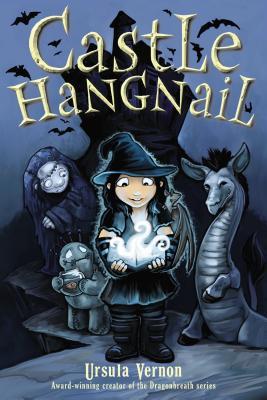
Ursuala Vernon creates the perfect little Wicked Witch for "Castle Hangnail"

22504710

The beautiful writing style of Ursula Vernon paints a backdrop for this little the likes of which is not often seen in juvenile fiction, or adult fiction for that matter.  The ensemble of characters each have their own, well-rounded personalities, and distinct voices.  Though most of the story is told through the eyes of Majordomo, the hunchbacked guardian of the castle, the rest of the cast feels just as important and central to the story.


There was some concern, near the beginning of the story, that Molly Utterback didn't fit with the rest of the cast.  She felt too insignificant in comparison.  While the other characters had obvious motives, desires, and traits, Molly was intentionally hiding who she was, which kept her in the shadows of the others.  The parallel between how Molly fit into the story and how the writing of Molly fit with the writing of the other characters leads me to believe that this was actually intentional on the part of Ursula Vernon.  As Molly begins to open up to the other characters, the writing of her becomes more stable and feels less disconnected from the rest of the story, just as Molly is finding her place in Castle Hangnail.


Molly is a 12-year-old girl with some innate magical talent and a belief that she's destined to be a wicked witch, rather than a good one, because she has an identical twin sister who is incredibly bubbly, friendly, and loves the color pink.  Molly learns some spells from a teenage evil sorceress in her home town, and steals the sorceress's invitation to come live at Castle Hangnail as its new Master.  When Molly arrives, Majordomo is unconvinced that she belongs there.  He is worried that she's not wicked enough, or perhaps not witch enough, to be the new master of an evil castle.  But the rest of the minions take to her with ease, and she quickly picks up new spells that endear her to the local village as well as the local wildlife.  Her natural talent with herbs and a quick friendship with a plant loving neighbor, have the castle gardens looking well in no time.  But, when the evil sorceress comes to take possession of the castle, Molly must decide just how wicked she is ready to be.


The choices Molly must make, and the revelations that she goes through, regarding how others see her and have used her, may be fantastical, but they are relatable to any young person who is trying to figure out their place in the world.  We all have natural talents and compulsions, and some of them aren't much approved of by our parents, or taught in our public schools.  Molly makes the decision to go somewhere she believes she belongs.  She tries to be what she thinks they'll expect of her, but learns that being herself, and trying to do the right thing are the only ways to find out where you fit in this world.  Molly finds her true home and learns that there are fewer limits to her abilities that she could have ever dreamed.

The Boxcar Children series stumbles with Special #3: "The Mystery at Snowflake Inn"

363342
It's difficult to read a book meant for children when the language is so clearly not childlike.  The use of proper grammar in every sentence, an utter absence of slang or local vernacular, the constant use of "yes" instead of "yeah" or "okay" make the book feel more like a 10 page beginner reader, rather than a 100+ page chapter book.

As for the mystery in this story, there seems to be a lot of jumping to conclusions on the part of the children.  The Aldens, along with their cousin, Soo Lee, are at a Vermont Inn for the holidays (it’s never stated, but the holiday is obviously Christmas).  The first incident that gets their mystery caps on is that the horses for the sleigh rides are let out of the barn.  Now, I’ve lived on farms and know that it is in fact possible to accidentally let the horses out.  Horses are smart creatures, and if you don’t lock the pens up real tight, they can finagle many types of locks open again and get out.  It’s also possibly, considering how obviously understaffed the inn is, that the person in charge of locking them up at night got distracted by one of the many plumbing issues and fire hazards around the place, and forgot to check all of the locks before leaving the barn.  However, the children automatically assume that someone intentionally let the horses out of the barn.  While this turned out to be true, it is not a necessary conclusion given the circumstances. 

The only clue the children unearthed by snooping around was that there were strange bootprints in the snow outside the barn that could match either the Inn owner’s son, Larry (who was the one to go out to the barn and discover the horses were missing, so of course his bootprints were there) or Larry’s cousin, Betsy (who’s an avid rider and goes to the barn every day, so her bootprints would be there, too).

The suspects are easy to identify, as everyone in the inn loudly expresses how they feel about every little thing at all times.  No one seems to be harboring any secret motives as their intentions are all out in the open for anyone to see.  The son wants to take over the business and make major renovations.  The cousin thinks the place is a dump and doesn’t want to be there or around anyone (she comes across as a spoiled brat).  The two kids staying at the Inn with the parents really don’t want to be there and just want to go back home.  The cook is fed up with the poor excuse for a stove she has to work with and keeps demanding that it get replaced (and when it craps out on her one too many times, she quits).  All these revelations take place in public, quite loudly.  There are no secrets at the Inn.  In fact, the “secret” passageway, that allows the culprit to sabotage the oven in the middle of the night, is shown to the Aldens by the Inn owner on their first day.


The children don’t actually solve the mystery at all.  The culprit becomes overwhelmed by the holiday festivities and confesses all.  Sure, the children are able to see how it was that the culprit did everything – but that’s hind sight rather than inductive reasoning.  They wouldn’t have been able to solidly identify the culprit based on the paltry “evidence” they’d amassed by that point.  Definitely not the Boxcar Children’s best work.

Tuesday, September 1, 2015

American Girl, Rebecca Rubin, solves the mystery of "The Crystal Ball"


12455938 True to the American Girl tradition, the stories of Rebecca Rubin integrate lessons about accepting diversity and female independence while offering an entertaining story.  In New York City, before America’s involvement in WWI, immigrant families lived and worked together, creating communities built on mutual trust rather than a common genealogy or first language.  This is why, when things start going missing in the brownstone where Rebecca and her family live, there is a high sense of betrayal.  The prime suspect in the thefts is Rebecca’s cousin, Josef, who’s come to live with her family for the summer.  As an aspiring carpenter, Josef has taken odd jobs in many of the apartments in the building, and appears to be the only person who had access to all the missing items.

Rebecca shows herself to be level headed, early in the story, when she’s quick to work out how a street fortune teller is likely reading body language and vocal cues to guess at her customer’s situation.  She even realizes that the vague answers the fortune teller gives out can easily mean a number of things, but the customer is quick to think it means what they want to hear.  Though Rebecca has a good head and a great deal of common sense for someone so young, she is still drawn into the hype over the stolen items, and allows herself to wonder if her cousin could be guilty.  When she notices him coming out of a pawnshop, she begins to worry that everyone’s accusations may hold merit.  Finding an excuse to scope out the pawnshop leads to further doubt when she notices items for sale that may very well be the items in question.

Not one to take appearances at face value, Rebecca keeps digging into the issue.  She is the first to posit that the buildings interim handyman, Mr. Silver, is a little suspicious – maybe too friendly, always hanging around, and able to pick locks with a hairpin.  Though Rebecca’s older sister, Sadie, doesn’t believe it could be Mr. Silver, she is willing to support Rebecca in her quest to find more information.  When the building’s janitor, Mr. Rossi – who’s laid up with a broken hand – wants to take his deceased wife’s special candlesticks to a fortune teller that Mr. Silver pointed him towards, Rebecca’s suspicions increase, and she and Sadie follow after.

Rebecca’s determination to find the truth, rather than accepting things as they seem, and her determination to see her friends taken care of, lead her to finding the thief, and she’s quick to figure out how he pulled it all off, too.  Even after she’s put in danger, she refuses to back down, and stands up to the pawnshop broker who bought all the stolen merchandise (and was refusing to sell back the family heirloom Josef’s father was forced to pawn earlier that year when the family wasn’t making ends meet).  She shows that keeping one’s head, not jumping to conclusions, and watching out for your friends is within every girls’ power.

Wednesday, August 12, 2015

"10 Things to Do Before I Die" by Daniel Ehrenhaft could have been more than what it was.

451944
When you are a teenager, life seems endless.  There are a million possibilities that stretch out before you.  You can do anything you want, be anything you want.  There is nothing holding you back.  Unless you are Ted Burger.  His day started out so normal: going to school, playing guitar, avoiding the girl he's not sure why he's dating, and then hanging with his two best friends at their favorite burger joint.  That's when things start going downhill, for both Ted, and the reader.


Ted is finding it hard to breathe, and we, the readers, are finding it hard to believe that no one in this young man's life stops for five seconds to help him calm down.  Everyone is just running about their lives, telling him it's going to be okay, but not pausing to show him that he's not actually dying (oops, spoiler alert).  A quick conversation with a nurse, who wants him to stick around for more tests, has him more nervous than calmed.  A phone call to the doctor father of a friend has him more confused than mollified.  And the internet (a teenager's home away from home) gives him the answer he's looking for: he will be dead in 24 hours.


His best friends latch onto this announcement from Ted like it's gospel, and a crazy night ensues, doing all the things Ted has ever wanted to do before he dies.  Granted, he does get to do some amazing things, like jamming on stage with his favorite band.  But the audience is dragged through a series of short interactions with the people in Ted's life, all of whom he seems to be trying to run away from, and the only one who is able to hold his attention, and could have possibly calmed him down and made him see what was really going on, was so caught up in the night that she hardly even questioned the story, which culminates in a stand off with the TSA as Ted is trying to hop a plane to Africa.


It's not hard to like Ted in the beginning.  He seems level headed and observant.  He's smart and kind, and he's great at the guitar.  He's the kind of guy I would have liked to be friends with in High School.  But he's kind of an idiot about his own health and how to deal with stressful situations.  His reaction to his medical problem seems disconnected with the early calm and steady Ted we are introduced to, and the fact that so many people just accepted the internet's prediction that he was about to die is either unrealistic, or a sad commentary on modern reliance on the internet.


For such a promising opening chapter, this book was sadly disappointing.  But I would be willing to give the author another chance.